
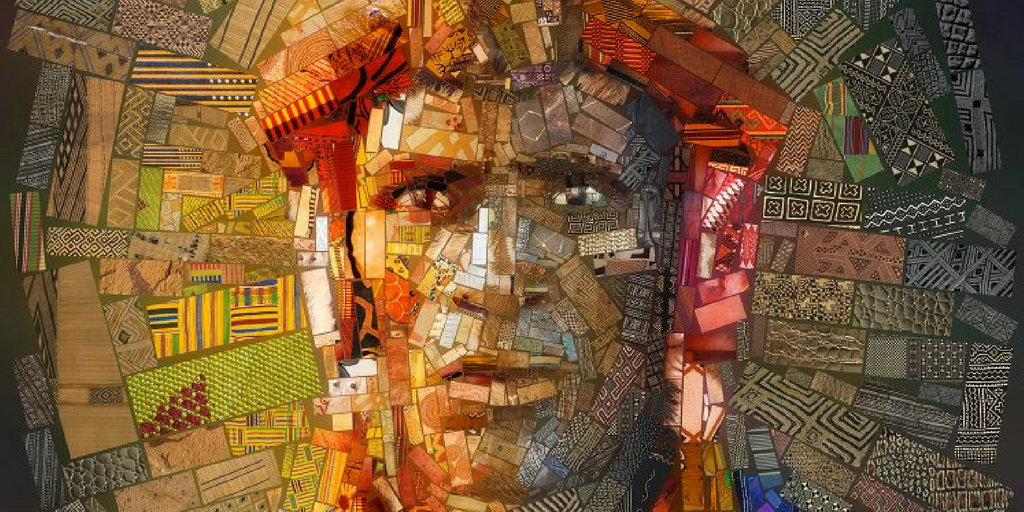
Africa’s history is not just about slavery and colonialism. Yet, there has always been a darkening, intentionally or not, of our history. Through different periods and characters, Africa clearly has something to be proud of. We have many heroes. These Irawos from a relatively near or distant past who added value to our history.
This article is the first in a series of 5 about African heroes. Let’s open the ball with Shaka Zulu.
Shaka Zulu, the origins
In the region of present KwaZulu-Natal (a province of South Africa), in an atmosphere of inter-tribes wars and an imminent threat of colonization, was born Shaka Zulu, within the Zulu tribe of the Nguni people.
Fruit of the illegitimate union of Nandi, a Langeni princess, and Senza Ngakona, leader of the Zulu clan, Shaka was considered within the tribe as the ugly duckling. It must be said that he was conceived during the Ukuhlobonga, a sexual act without actual penetration, allowed to unmarried couples; only that his parents got visibly carried away. This is how the one we all call Shaka came to the world.
The surprising truth is that his father named him Sidi and not Shaka. But because of his illegitimacy, he was called Shaka, with particular reference to a disease called “Utshaka”. The family of his mother, Nandi, refused to believe she was pregnant since she wasn’t married; thus, assimilating the pregnancy of the mother-to-be with the symptoms of the Utshaka.
This is how Sgidi, called Shaka, grew up in the classic scenario of the unloved child that everyone calls a bastard (like Jon Snow from Game of Thrones). The young Zulu would thus forge a strong personality eager for power.
The birth of a mighty warrior
His warrior spirit met its genesis when he went to the Batwetwa, another Nguni tribe. He joins its army. The ugly duckling begins to turn into a Royal Eagle. Charismatic, quick-witted, tough and gifted with stunning physical strength, he keeps defeating his opponents on the battlefield, expanding his reputation to the point of becoming the right hand man of Dingiswayo, the leader of the Batwetwa tribe.
While he’s on the second step of the podium under the Batwetwa leader, Shaka hears about the death of Senza Ngakona, his father and the succession of one of his half-brothers Sigujana at the head of the Zulu tribe. This, despite the fact that Dingiswayo had previously agreed with Skaka’s father (who became his illegitimate son admirer in the meantine) to make the young warrior the legitimate heir. With the help of Dingiswayo, the valiant Zulu took what was his right. He fought a battle against his half-brother and won with flying colors.
The outsider is now at the head of the Zulu. The child prodigy is back.
Shaka “Curiosity” Zulu
Shaka Zulu was more curious than any child. He always wanted to know everything: know how things worked, discover new places, new lands no matter the cost. For example, he opened a pregnant woman’s belly to see how the child to-be-born occupied the space. Some historians imply that Shaka ordered the removal of a man’s eyes, just to know how the latter would adapt.
Shaka Zulu also traveled a lot. He travelled all over the country on foot. Some places known today in KwaZulu-Natal have been named according to Shaka’s first interactions with them. We can mention the seaside town of Amanzimtoti. Shaka gave it that name after quenching his thirst in the river. He exclaimed: “Kanti amanzi mtoti”, which means “how sweet this water is!”.
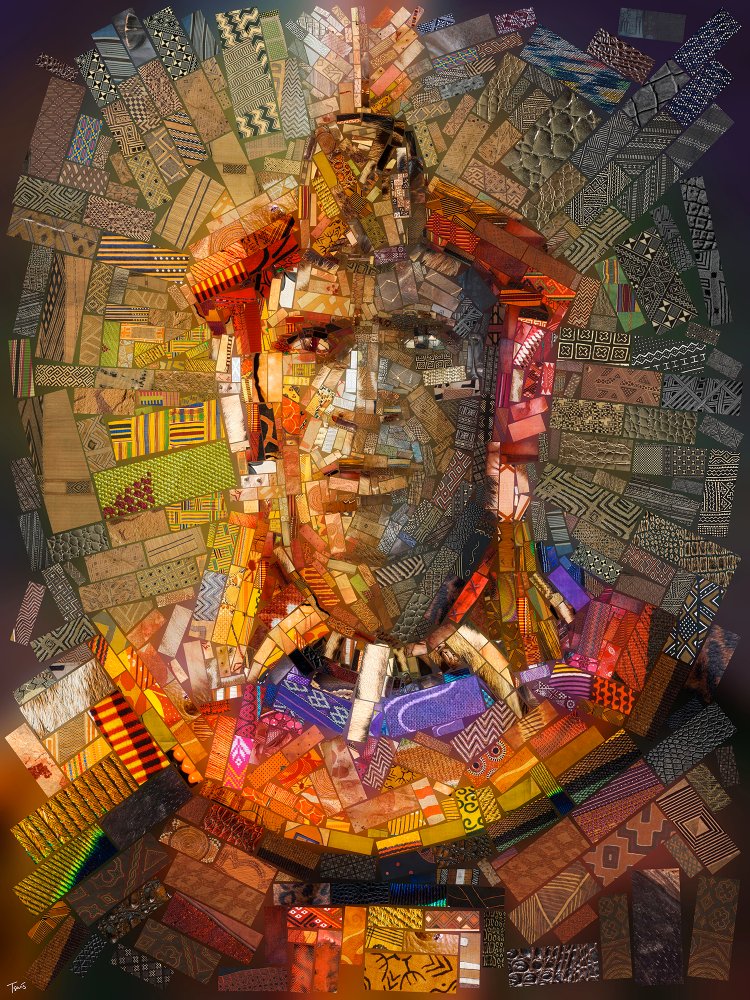
More than a warrior, a strategist
The reputation of Shaka well seated, he has no trouble imposing himself within his tribe. As a great visionary, he’s quick to submit his revolutionary political and military ideas. He names his people Amazoulou: “those of heaven”; name that would later be shortened “Zulu”.
He proceeds to the update of the war techniques of his people. He trades the long “Assegai” spears used by his warriors to enjoy long-range attacks , with short “Iklwa” blades, more effective in close combat, and which remind of the armament of the Dahomey Amazons regiment.
For this purpose, Shaka initiates a “buffalo head” offensive strategy : the troops are split into four regiments, two of which form buffalo horns and two central regiments in line form the skull. In a rotational movement, one of the horns attacks, while the other one remains hidden and moves only when the fight is engaged (pretty smart, uh). In addition, his warriors had amazingly strong cow skin shields introduced by Shaka. These cowhide shields were stronger than the iron and wood shields made at the time.
An era of conquest signed Zulu
With an unprecedented strength, Shaka Zulu begins an era of conquest. He goes from victory to victory as usual and incorporates other tribes to his people. His is so powerful that some tribes voluntarily join him. He intends to unify all the Nguni people (we could wonder if the character Jon Snow was inspired by our valiant Shaka).
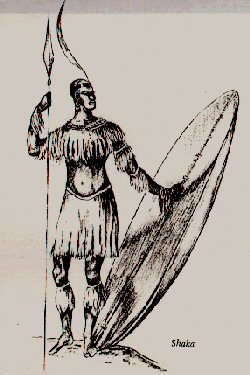
This picture is, by the way, the only original representation of him.
Beyond his great gift for military strategy and his intimidating stature, Shaka shows a remarkable social discipline to achieve his goals. Young people (16 to 60 years old) join the army regardless of their gender. The younger (under 16 years old), the old and the disabled take care of production tasks such as breeding, fishing and agriculture. Furthermore, only deserving warriors, aged 30 to 40, have the right to procreate.
The authority is military and absolute. It was this mixture of military strategy, social discipline and passion that made Shaka’s strength as a conqueror. At his peak, his army had more than 100,000 men and about 500,000 from neighboring tribes. Shaka Zulu had conquered a territory much larger than France, that is more than 643,801 km2 whereas at the beginning of his reign, his territory did not extend over more than 100,000 km2.
Until now, he continues to conquer the minds of more than a thousand, being present with the entire Zulu tribe in the video games series Civilization, for the ones who are very keen on virtual strategy games. He also seduces lovers of letters and history through the famous novel by Thomas Mofolo: “Chaka : A Bantu epic“.
Share this article for the glory of Shaka Zulu.